Laws to Help Families of Missing Persons Us
Native American tribes and nations across the land say their members are murdered or go missing in alarming numbers, victims of domestic or drug-related violence, sexual assail or sex trafficking. And families of the victims say law enforcement is non doing enough about the problem.
Pinning downward exact numbers is difficult. Individual states maintain databases on missing persons, only they don't necessarily coordinate with one another.
The U.Due south. Section of Justice (DOJ) administers two national databases: the National Offense Information Center (NCIC), a central resource for reporting and tracking offense, including missing persons, and the National Missing and Unidentified Persons System (NamUs), a searchable, online database of information on missing persons and unidentified remains. Equally VOA learned, though, those systems are full of holes.
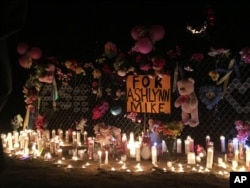
"If I threw a number to you lot, it would simply be a number," said Janet Franson, a retired Florida homicide detective now living in Texas. She starting time noticed the problem several years agone while working for NamUs.
"I covered nine of the Northwestern states and more than than 40 reservations," Franson said. "And I started realizing that there were people going missing who weren't fifty-fifty getting reported. In some cases, nobody fifty-fifty knew that they were gone."
Today, Franson tracks missing and unidentified bodies of Native Americans and posts them on Facebook. Almost of the cases she encounters are adults.
"When juveniles go missing, there's a federal mandate that says police force enforcement must file a missing person written report and enter the kid in the NCIC within two hours. But at that place is no mandate for adults," she said.
The system depends on families to notify law when relatives get missing. Information technology also depends on law to fill out a missing person study.
"Sometimes police force just don't desire to be bothered," Franson said. Making matters worse, smaller reservations may not have access to NCIC computers and must rely on local or state police to do the reporting for them, equally a courtesy.
Constabulary indifference
At to the lowest degree two persons are currently missing from S Dakota's Pino Ridge Indian Reservation, home of the Oglala Lakota Sioux.
Alex "Tank" Vazquez, 26, disappeared in October 2015.
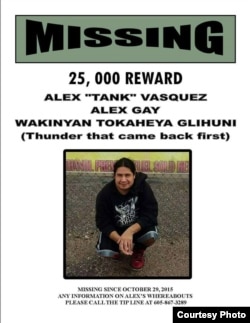
"I was on my way to Mexico on holiday when my other son called and said Alex hadn't come dwelling house," said Alex's father, Mario Vazquez. "I didn't think it was anything, but when I came back, I started seeing all the comments on Facebook, and then I started hearing rumors about him being killed by his cousins, nigh them killing him and feeding him to the pigs. I was going crazy."
Vazquez filed a missing person report with the Oglala Sioux Tribe Section of Public Safe, which conducted air and land searches across the reservation. Simply that was ii years ago, Mario Vazquez said. Since then, he said constabulary don't talk to him at all, and friends and family members have taken on the search for Alex themselves, circulating flyers, posting notices on Facebook and organizing search parties.
"It'southward been a nightmare for me, and I don't go any help from everyone. I just need to know what happened," he said.
VOA heard similar complaints from the Navajo Nation, where at least 29 people are currently listed as missing, among them, 26-twelvemonth-old Katczinski Ariel Begay.
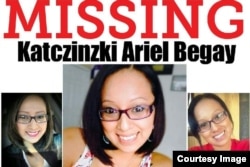
"I terminal saw my girl July 3 when she walked out of the door with her boyfriend," said her mother, Jacqueline Begay. "The last thing I heard from her, she texted me and said she would be home later that evening. Only she never came home."
Witnesses claim to have seen Katczinski Begay getting into a Jeep parked outside a souvenir shop.
"The criminal investigator said she hasn't even checked the store'south cameras nevertheless. All she tells us is that she has a lot of other cases to handle and that she'south a single parent," Jacqueline Begay said. And one time police establish out Katczinski Begay had habit bug, she said police force showed even less involvement in the case.
"That'south a common problem," said Meskee Yatsayte, a Navajo denizen who devotes a Facebook page to sharing data on missing tribal citizens. "As before long equally you lot mention to police that the missing person likes to 'party,' they shove the case off to the side."
Resources stretched thin
In fairness, Yatsayte said Navajo Nation police force have express resources.
"Right now, we have 134 police officers to embrace 27,000 square miles [70,000 square kilometers]. Every officer has to patrol a 70-mile radius. And that means when somebody goes missing, it can accept anywhere from two to nine hours to respond," Yatsayte said.
And this assumes that families have telephones or houses that are numbered, which many, particularly in remote corners of the reservation, are non.

"We actually need a missing persons unit, someone who can concentrate to become these cases solved and go some answers for these families that are suffering every day," she said.
Navajo Nation Police Captain Michael Henderson said his officers do their utmost to help families of the missing.
"If there is suspicion of criminal activity, police officers will exercise a preliminary investigation and so turn it over to criminal investigators and the FBI," Henderson said. "If there is no reason to suspect criminal action or homicide, officers will take a report and enter it onto the NCIC database, as well every bit whatsoever Dna prove they have, and behave monthly follow-ups to see whether there's whatsoever new information on the cases. They volition continue until the missing person is plant or they reach a consummate dead end.
"Only we are chronically undermanned to be able to do effective follow-up," he admitted.
Currently, more than than 200 police departments operate across Indian Country, which is defined as all land falling inside the limits of any reservations under the jurisdiction of the Us government.
The departments range in size from only two or 3 officers to more than than 200 officers. And according to the California-based Tribal Law and Policy Found, that'due south about one-half the number needed to properly service tribal citizens.
The murder rate on Pino Ridge Reservation, for example, jumped xc percent in 2016, but has a law of only about thirty officers who must cover an area of nigh three,400 square miles (8,800 square kilometers).
"Although cynicism, complacency and incompetence explain some of the reactions by law enforcement, the primary reason for this kind of response is a lack of resource, especially, personnel who are stretched too sparse," said Jeffrey Ross, a professor of criminology at the University of Baltimore and expert in justice in Indian State.
Almost tribal police departments are funded by the Interior Department'south Bureau of Indian Diplomacy (BIA), which is chronically underfunded.

Attorney Full general Jeff Sessions has acknowledged the "practical and jurisdictional challenges" facing tribal police.
"Police enforcement in Indian Land faces unique practical and jurisdictional challenges, and the Department of Justice [DOJ] is committed to working with them to provide greater access to technology, information and necessary enforcement," Sessions said in Apr, announcing DOJ will expand tribal admission to national criminal databases.
A new Indian Country Federal Constabulary Enforcement Coordination Group comprising elements from a dozen federal agencies will convene to collaborate and coordinate efforts to counter crime on reservations. And he said the government will also carry a series of listening sessions with tribal leaders and police in order to assess their needs.
But at the aforementioned fourth dimension, the White House wants to cut about $30 million from federal programs that help tribes fight criminal offence.
"The proposed budget cuts will have a devastating effect on the ability of tribal law enforcement to accomplish all of their interrelated goals, and not simply responding to missing persons reports," Ross said.
And that leaves families with even less reason to hope.
"More and more missing persons cases are reported every day," missing persons advocate Yatsayte said. "Eventually, they'll just end upwardly as cold cases."
Below, some of the many missing persons and unidentified remains in Indian Country:
Annotation: An earlier version of this story identified Janet Franson every bit working for the National Center for Missing and Exploited Children rather than NamUs. The story has been corrected.
Source: https://www.voanews.com/a/families-of-missing-native-americans-cite-police-apathy/4019017.html

Post a Comment for "Laws to Help Families of Missing Persons Us"